


Dinner for the Damned


Trenchbroom


Solo
8 weeks

About

Key Responsibilities:
Dinner for the Damned is a custom Quake map created as a single player experience, with a unique focus on re-entering a collapsing room from different angles to discover new vantage points.

Built & applied a modular kit to the blockout processes
Texturing and lighting


Level Overview


Player Goal: Collect the golden key and defeat all enemies to exit
Player Experience: Foreboding, Tension/Suspense, Discovery
USP: The player returns to the same room multiple times, only to find it more destroyed each time. This creates now platforms to previously blocked off areas.

Dining Hall
Design Pillars
Visual Leashing

As the player, lights and textures should feel natural and guide my line of sight to points of interest.
Traversal
As the player, I want pathways to feel like part of the world I am traveling in, showcasing a clear pathway.
Perspectives
As the player, I want to gain new experiences and perspectives when re-entering the same room multiple times.
Concepting a Level
Research


Every level needs a starting point. Here is the process I went through to create a concept pitch for my level.

When concepting a level for an existing title, I found it important to have a concrete understanding of the gameplay, enemies and affordances that come with the game itself. Therefore, I conducted research on Quake to understand the ways the game presents its challenges to the player. I additionally researched castle traps and architecture to integrate this into my level design process.


Sketching

When concepting a level, I like to start by finding inspiration and sketching overviews of room layouts. I decided to look into inspiration from Great Halls and medieval architecture, sketching out any spaces I enjoyed visually. This way I can create a strong foundation for the concept of a level.


Testing


To me, it was equally as important to learn the different metrics of Quake in order to create a level that would traverse smoothly and enhance the gameplay. By using a Gym, I was able to quickly iterate on ideas, test out different mechanics and understand the fundamentals to form a modular set of rules that helped me build my gameplay.
Iteration

After testing out an idea for a ‘trap elevator room’ in my first concept idea, I quickly realised that the idea wasn’t as fun as I had hoped for. Rather, the core fun was found in returning to the same room both at the start and end of the level, leading me to rework the concept to center this theme

.png)


Designing Combat Beats

The Dining Hall
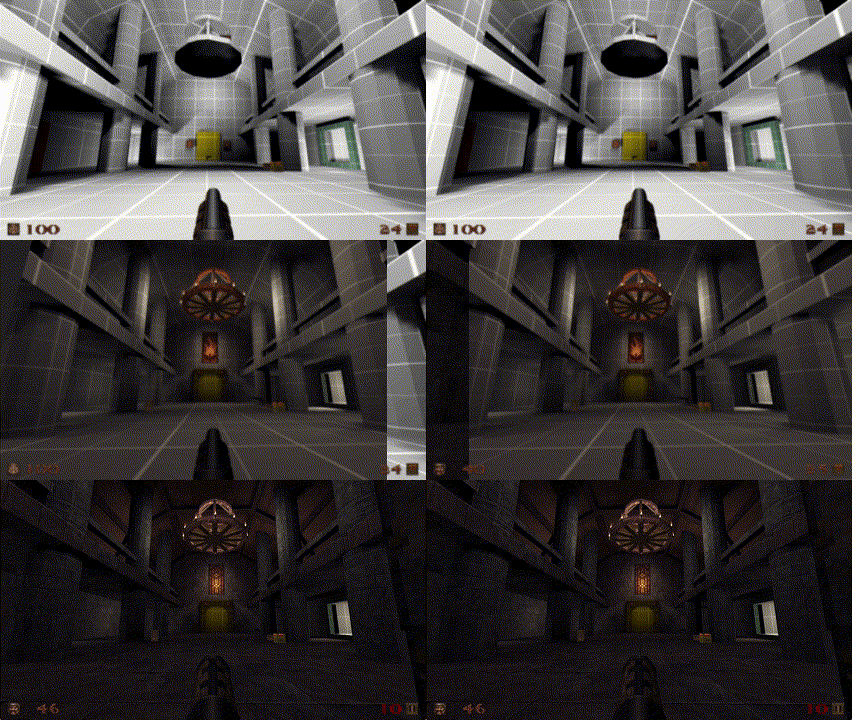
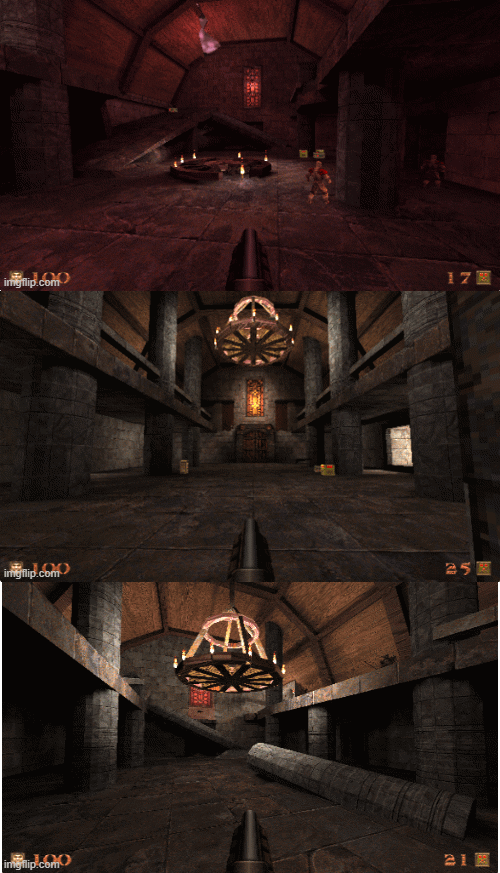
As the level revolves around entering the same room multiple times, I needed to make sure the room was recognisable in geometry, with key points of interest. This is the reason why I developed the chandelier in the centre of the level, while it not only serves as an anchor for the player to recognise the room from, but is incorporated it into the level and combat space.
The room contains multiple points of interest in every instance: The Chandelier (Complete, Lowered, Destroyed), two stained glass windows on either side, 3 doorways that open with progression, large pillars and a padded roof (which fall and break increasingly in each instance).
Points of Interest: Making a Room Recognisable


Further Breakdown: Instance 1


In the first instance of the Dining Hall, the goal is to establish a recognisable space by drawing player attention to key repeated elements. Therefore, I created the chandelier to be the main source of light in the room, with the intention of drawing the players attention alongside the high ceilings.
Combat (Dining Hall v1): The player is assaulted by a small group of Scrags, flying enemies that force the player to look upwards and take in their surroundings while being pushed through the scene from their projectiles. This enforces the focus on the chandelier.
Shifting perspectives


Foreshadowing
I wanted to entice the player, and build atmosphere and anticipation. Therefore, I placed a nail gun in an unreachable position, that the player can only reach when returning to the room the second time, through the upper landing and a broken pillar that creates a bridge to reach it.
In the second instance, the player can hear a loud crash before they enter the upper landing of the dining hall. Here they can clearly see the chandelier has fallen lower, alongside pillars that are knocked over. The player is able to cross the room by traversing on the chandelier.


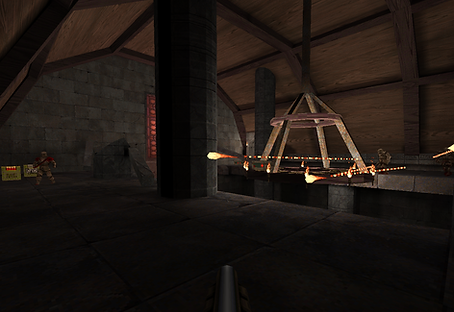
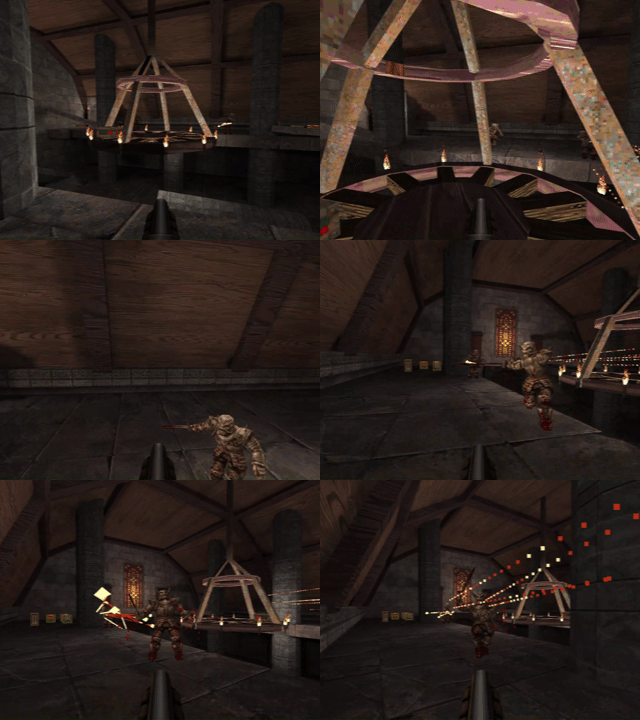

Combat (Upper Landing): The player fights two death knights and a knight in this upper landing. The projectiles of the two distant Death Knights push the player around the upper landing, forcing aim and dodging by moving behind pillars.
The broken pillar serves as an easy way back up if the player were to fall down, while also serving as a diagetic obstacle to stop access to the door to the previous hallway, increasing immersion and atmosphere.
Further Breakdown: Instance 3
Layered Combat:
Increasing Tension
In the last instance of the room, the player enters from the previously barred teleporter. The Dining Hall is now almost completely destroyed, a shattered chandelier with a few remaining lights flickers on the floor, with the yellow light contrasting the red glow. As the climax of the level, this room has scripted combat encounters that serve as a final challenge for the player.


Combat (Dining Hall v3): The player enters the room to a group of knights, pushing them around the space. Another door opens to an ambush from a Death Knight, leading the player to push towards higher ground. The chandelier is now an obstacle on the floor.


Combat (Dining Hall v3): Once the player enters the ramp formed from the broken upper landing, or has killed the knights, a group of scrags is spawned to increase the tension and intensity of the fight. They balance out the 'power' that the player gained from moving to a higher ground.


Combat (Dining Hall v3): After this, an ogre is spawned into what remains of the upper landing, throwing grenades and inviting the player to finish him through climbing the ledge. This leads to them gaining the rocket launcher and a direct line of sight to the Quad damage.


Combat (Dining Hall v3): A Shambler is spawned into the centre of the room. The pillars and elevated platform allow the player to hide from the lightning. The elevation allows the player to collect the Quad damage and slay the Shambler before exiting the room with the golden key.


Implementation
Blockout
Lighting pass 1
Iteration
Further Breakdown: Instance 2

Blockout


Implementation
Combat Pass 1

Lighting & Texturing
Size, Form & Function
Within the level, I wanted to provide a build up of tension and release, in order to build engagement with the player throughout combat spaces. In order to do this, I found it important to have a clear design intent towards each scripted encounter and room created.

The Cellar
The cellar is the stark contrast of the previous main Dining Hall that the player enters from. There, the ceiling is large and open, down here, the ceiling is low and the shelves are cramped. The space is intentionally tight to build tension.
Further Breakdown

Iteration & Playtesting

Revising Rooms
After conducting multiple playtests, I was able to revise the combat encounters to better fit the space given, and to enhance the player experience created.
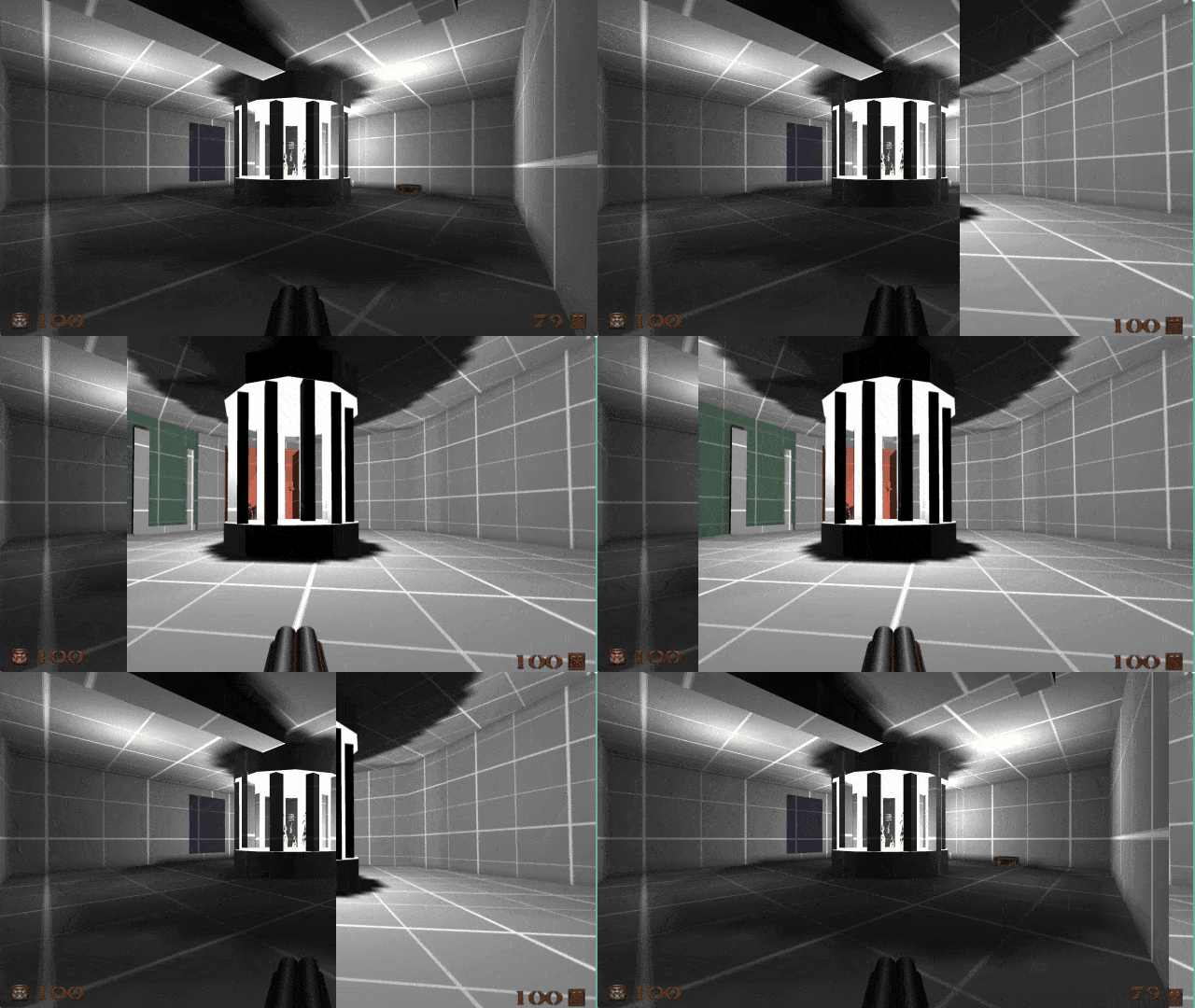
Originally, the dungeon was a square room containing multiple closets that opened up to reveal enemies. Through playtesting, I quickly discovered that the square space was uncomfortable to traverse with the circular 'key cage' in the middle. The closets were contained some health and ammo, but this was awkward to collect, and overall the room had a rather frustrating combat beat. It was time to change.
The Dungeon


Initial Idea Sketch

Initial Blockout
The inital sketch showcasing the square room with closets that spawned enemy in a sequence


Revised Layout Sketch
The first blockout that tested this combat beat. The square room and low ceiling were criticised in playtests.
The revised plan for the room, showing an octagonal layout that facilitated the space.

Revised Blockout
Layout Overview
The revised blockout with combat. It features a series of interconnected closets that allow the player to fully traverse the room through the corridors, where ammo and health packs are also located.
The Quake Community
Alongside this, I was able to post my level on the Quake mapping Discord, allowing community members to engage in the level I had created and provide direct and experienced feedback to some of the design challenges I was facing.
This was a really great experience for me, as I could see what it would look like for people outside of my bubble as a game designer to play my level with completely new perspectives. I got a lot of tips and feedback on what to improve on for the level, such as how to texture certain items to align more with the 'Quake standard', and how combat beats or rooms could be improved upon.


Project Takeaways
This project provided me with a concrete understanding of the level design pipeline. As an entirely solo project, I was able to explore every aspect of the process. I found Trenchbroom a delight to work in, and the engine’s challenges pushed the level in creative directions when solving problems like creating complex architectural geometry.
Playtesting and constant iteration were crucial to the process. Boomer shooters were new to me, I had to learn the medium quickly and embrace mistakes. Ripping off the bandaid and getting familiar with the tools taught me that not every idea works on the first try. Iterating on my concept pitch and reworking beats to create the best experiences was difficult, but it ultimately brought the level together into one coherent vision, and taught me a lot along the way.
I loved breathing life into this concept. I especially enjoyed the attention to detail I could place in every room, selling the immersion. I wasn’t just crafting a playspace or combat arena, I was building a world and story around it. Adding environmental effects as the player moves through the space, such as falling rocks accompanied by rumbling sound effects, was so engaging to develop.
When the level finally came together, learning lighting and texturing proved deeply rewarding and fundamental to my growing understanding of level design for boomer shooters

